
Our Blog

Motivating People with Autonomy, Mastery and Purpose

Posted December 27, 2010 8:22 AM by Dylan Miyake

In my previous blog post, I shared some stories from Dan Pink's book Drive on the new science of motivation. This book has been highly influential in causing many organizational leaders to re-evaluate their ideas about the best ways to motivate people.

In companies and organizations that thrive on creative thinking and innovative solutions, financial rewards and external "carrots and sticks" are being replaced with a new management doctrine of Autonomy, Mastery and Purpose.

But do these ideas really work? What are some real-life examples of Autonomy, Mastery and Purpose, and how can your organization adopt these ideas in your workplace?

Encarta vs. Wikipedia

You don't have to look far for a perfect illustration of Autonomy, Mastery and Purpose. It's a story of two competing projects, pitting hundreds of unpaid volunteers against the mighty Microsoft.

Microsoft Encarta was started back in the mid-1990s. Microsoft paid professionals to design and write an online encyclopedia. Project management practices were implemented to sure it was done on time and done in compliance with all the specifications from leadership.

Encarta essentially said "Let's do this by the rules," and reinforced specific behavior by financially rewarding timeliness and quantity of output. Microsoft then bundled and sold this software as a CD.

As a contrast, Wikipedia was started in 2001, using thousands of mostly anonymous online volunteers to build an encyclopedia. But instead of selling the encyclopedia, Wikipedia made it freely available to the public on the World Wide Web. Instead of rewarding writers with financial incentives, Wikipedia's only reward was its sense of community. Wikipedia rewarded its online volunteers by uniting them in a common purpose and giving special public recognition for those who "went the extra mile" with their contributions.

Instead of doing it "by the rules," Wikipedia said, "Let's do this for fun!"

And whether they intended to or not, Wikipedia created the perfect culture of Autonomy, Mastery and Purpose:

  • Autonomy: Thousands of people working on their own, for fun.
  • Mastery: Adding one's own expertise and earning respect within the community.
  • Purpose: Being part of a movement to create a shared body of knowledge for the world.

Encarta was a job. Wikipedia was a historic mission.

Encarta only published about 62,000 articles in six languages, despite an eight year head start on Wikipedia. The Encarta articles did not have communal input, did not promote autonomy, mastery, or purpose, and Encarta did not succeed. Eventually Microsoft conceded defeat and shut down Encarta in 2009.

Meanwhile, nine years later, Wikipedia is succeeding beyond even the wildest expectations. It is one of the most-visited websites in the world, with 78 million monthly visitors, over 17 million articles, and is available in over 270 languages.

Wikipedia continues to grow with thousands of daily additions in hundreds of languages. And they have continued their culture of Autonomy, Mastery and Purpose by providing a sense of community and rewarding those who "go the extra mile" in adding, editing and moderating content.

Tying incentives to performance

So how can your organization best reward your people if "rewards" don't matter?

The best ideas for incentives come from public recognition of good work. In Wikipedia's case, rewards do not come in the form of a bonus check. But for those individuals who are dedicated and active on the site, they can be honored by becoming a Wikipedia administrator.

With administrator privileges, the honoree gets an added level of Autonomy, Mastery and Purpose. They have the responsibility and privilege of being responsible for the final draft of articles that will be read by millions of readers. They are intrinsically motivated because their work is its own reward.

Wikipedia administrators don't get paid in money, but they get rewarded by being the gatekeepers and standard bearers of a movement that they believe in. Within the community of Wikipedia contributors, this honor is worth more than money.

Atlassian and "FedEx"

Another example is a software company called Atlassian. Atlassian hosts a 24 hour event called "FedEx." During "FedEx," Atlassian developers are given 24 hours of free time to work on anything they want, but they have to "Deliver something overnight." It sounds like a recipe for chaos and wasted time – but "FedEx" has become one of the company's biggest success stories, with the special Autonomy time leading to many important product developments.

Why does it work? The "FedEx" winners are heartily celebrated within the company. Winning the "FedEx" presentation is widely prized within the company – much more than arbitrary cash payments would be.

Through this event, Atlassian gives its employees Autonomy, Mastery and Purpose.

  • Autonomy: Freedom to work on whatever they like.
  • Mastery: The chance to develop something that they're experts in and truly care about.
  • Purpose: Feeling connected to a high-visibility, exciting opportunity that matters to the company and is admired by their colleagues.

"Sure, it sounds great," you might say, "But I've never heard of Atlassian... "

Have you ever heard of Google?

Google – 20% Time

This 21st century phenomenon intentionally under assigns each employee. Google gives every employee "20% time" – the equivalent of one full workday each week to use their time however they see fit. Google employees use 20% time to invent, explore and work on any projects they are interested in, in any environment they like. Google's "20% time" has resulted in hugely valuable ideas. Gmail, Google News, and other popular services were invented during Google employees' 20% time.

Atlassian and Google both understand that the future is driven by new ideas and fulfillment of a larger purpose – and they give their employees the autonomy to pursue it.

Sharing Responsibility

Perhaps the most surprising lesson from Dan Pink and the new science of motivation is that greater freedom often results in greater responsibility. Given the chance, people will start to work harder and think smarter – for their own sake.

If employees are given simple tasks, clear goals, and promised more money to do more work in less time, the organization might make incremental improvements.

But if employees are truly motivated from within, then the sky is the limit. If employees have a spirit of Autonomy, Mastery and Purpose, they will have the freedom and inner drive to develop truly creative solutions. Intrinsic motivation – where work is its own reward – is the best way for your organization to achieve transformative goals.

Every organization needs to get the most out of its people, especially with the looming skills shortages that the U.S. workforce will be facing in a few years. Maximizing our human potential can start with trusting in employees and giving them the freedom to innovate.
 

Fostering a Creative Workplace – Beyond “Sticks and Carrots”

Posted December 21, 2010 8:11 AM by Dylan Miyake

For most of the 20th century, the quintessential American job was in a factory. Workers earned good incomes and middle-class lifestyles by doing repetitive, high-volume tasks. The way to motivate workers at these jobs was simple: "carrots and sticks." Pay people more money for doing more work, and punish people for breaking the rules.

Today, in the 21st century, the best organizations must act less like factories and more like think-tanks. The winners of the 21st century workplace will not be the ones who make the most widgets, but who can create and incubate the most creative and game-changing ideas.

But what many social scientists are discovering is that the motivational styles of the 20th century "factory" workplace do not work as well when motivating people to perform creative tasks. If the successful model for a 20th century organization was a factory, the successful 21st century organization will look more like a social movement.

This means that 21st century organizations need to embrace a new style of motivational leadership. Carrots and sticks must be replaced with deeper, more personal, more powerful motives for success.

Current research (outlined in Dan Pink's bestselling book Drive) is showing that when it comes to creative, innovative work, money is not what really motivates people. When organizations are really looking to achieve breakthrough innovations, they need to motivate their workers in other ways: by recognizing people's innate desire to be a valued team member who contributes to significant solutions.

Money only covers the basics like shelter and food. To encourage truly creative thinking, the work and related result must become its own reward.

What really motivates people?

To see great gains, organizations need to make a cultural shift away from short-term gains and contingent incentives. Instead of saying, "if you do this, then you will get that," organizations need to move toward a culture where people are self-motivated to do their best work. This is the best way to get employees to take responsibility, take (smart) risks, and develop truly creative solutions.

In July 2009, Dan Pink gave a talk to the TED conference about the surprising science of motivation. Social scientists and economists are discovering that when it comes to creative thinking, people are most strongly motivated by intrinsic factors ("doing things for their own sake") not from extrinsic motivators ("carrots and sticks"). To get the most creative solutions for your most complex challenges, you need to create a culture where people have Autonomy, Mastery and Purpose.

What do we mean by these terms? And does it really work?

In his lecture, Dan Pink discusses how experiments have shown that financial incentives only work for routine tasks. When there is a clear set of rules and a single solution, people can get the work done faster when they are promised more money.

The trouble is: most of the biggest challenges that our organizations are facing in the 21st century are anything but routine. Automation and outsourcing can replace any lower-level or repetitive task. For more complex cognitive thinking and creative work, financial incentives do not work. In fact, these financial incentives actually distract from truly creative solutions.

As Dan Pink says, "enticing people with a sweeter carrot or threatening them with a sharper stick" does not work in the business of thinking creatively.

In contrast to "sticks and carrots", Dan Pink introduces the concepts of Autonomy, Mastery and Purpose.

  • Autonomy: People feel an urge to direct their own lives.
  • Mastery: People feel a drive to get better at something that matters.
  • Purpose: People feel an innate need to be part of something larger than themselves.

If your organization can help your employees achieve feelings of Autonomy, Mastery and Purpose, you will likely "AMP" up your performance. Employees who have Autonomy, Mastery and Purpose are intrinsically motivated, full of internal drive. They're doing work for its own sake. They're doing work that matters, that interests them and that they feel is important. This is a huge difference in attitude from just punching a clock at the "factory."

Don't forget Maslow.

To be sure, money matters to some extent. People want to earn enough money to have food and shelter and a safe place to live. But once those basic needs are met (as Maslow's Hierarchy of Needs states), people aspire to meet higher needs – love and belonging, esteem, and self-actualization.

Once people have a decent standard of living, additional money doesn't really motivate them as much as Autonomy, Mastery and Purpose.

Organizational leaders are re-thinking some long-held assumptions about what truly motivates people. External motivators like money are less important (and less effective) than helping your employees light their own spark of motivation within themselves.


Do You Have Something to Tell the Government?

Posted December 16, 2010 9:29 PM by Dylan Miyake

If you have wanted to tell the federal government what to do here is your chance. The White House and OMB are seeking your feedback on an approach by which they can receive your expertise and input to the challenges on which the government is focused.

Filed Under Collaboration
more »

Overwhelmed and Underachieving? Consider using Strategic Initiatives

Posted December 7, 2010 11:48 AM by Dylan Miyake

Typically, organizations can identify hundreds of projects that "need" to be completed. Most of these projects address a problem, usually someone feels burdened to implement them, but oftentimes the leadership team has not identified, defined, or actively managed those projects for maximum strategic impact.

Without discipline from the top, hundreds of projects continue to go unfinished and over budget without any real impact on the organization's mission.

Perhaps it's time to try a new approach.

What are Strategic Initiatives?

Strategic initiatives are key action programs focused on achieving a specific objective or closing a gap between a measure's performance and its target. They provide organization leadership with a framework to review all the current projects, define the expected impact on the mission, and then focus on those few key projects that will cause immediate and measurable changes in how the organization functions. Strategic Initiatives are not "business as usual," they are the few critical projects key to improving an organization's delivery on its mission.

Defining and Prioritizing Strategic Initiatives

First you have to define the need: Why prioritize initiatives? You need to narrow the list of activities that the leadership team focuses on to the few things that will truly drive the execution of the strategy. The Strategic Initiative selection process begins by collecting a complete list of projects. All relevant information such as project budgets, expected benefits, risks, and owners or project managers should also be collected. Once this list is complete, leadership is ready to begin the review.

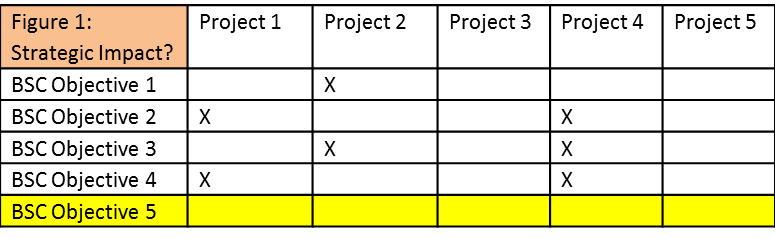
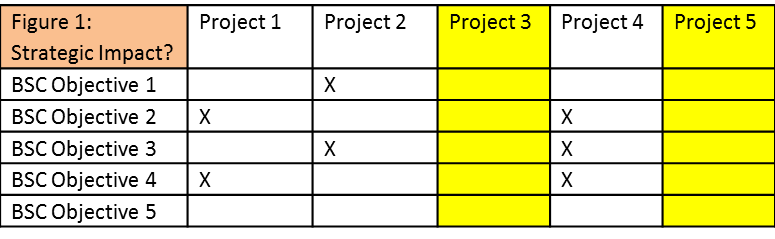
Each project should be plotted against the organization's Strategic Objectives. Add a mark for each Strategic Objective that the project will positively impact. See Figure 1 for an example.

Analyze this chart and begin prioritizing each project as High, Medium, or Low strategic impact.

Thinking about Alignment

Projects without strategic impact on any objectives are not good candidates to become Strategic Initiatives. Instead, these low-impact projects should be considered for cancellation.

In the same manner, if a Strategic Objective does not have any current projects supporting it, leadership should consider assigning new projects to support the Strategic Objective, or re-evaluate whether the objective is being sufficiently defined and delivered upon.

Selection and Implementation

Strategic Initiatives are like the U.S. Marines – "the few, the proud." The leadership team should be paring down the list to a select, high-priority group of Strategic Initiatives that will stand out against the noise of operational and day-to-day projects.

For example, some people within the organization might consider routine capital expenditures for preventive maintenance to be a project, but this is a task that does not have to be discussed and managed at the executive level, and it will typically not drive a change in performance of strategic measures. Strategic Initiatives need to be limited to only those efforts that have the potential for significant strategic impact on the overall organization.

Routine operations and low-impact projects are about "doing things right." Strategic Initiatives are about "doing the right things" that will make a big difference for the long-term strategic position of the organization.

Ideally, by the end of the selection process, the original list of many projects has been narrowed down to 8-15 Strategic Initiatives. Each of the initiatives now has a defined outcome directly related to the Mission and Strategic Objectives. Additionally, each Strategic Initiative also has an enthusiastic Owner who is responsible for drafting a budget and key milestones and then presenting this plan to the leadership team for approval.

Through the process of prioritization, the leadership team should be building consensus and understanding about how organizational resources will be best allocated in achieving Mission-Driven Success. There should be a major reduction in non-strategic projects, instead shifting to an alignment of effort behind these few key Strategic Initiatives. The entire organization, including leaders and those on the front line, should feel less stretched and more supported in completing the projects that will directly drive up performance measures.

Strategic Initiatives are not about "doing more with less," they're about helping your entire organization focus on doing the most important work, and setting aside lower-priority distractions.

Tracking Tools

Milestones are a key project management tool to use with Strategic Initiatives, serving as points in time when major tasks begin or end. The Initiative Owner is responsible for ensuring major milestones are completed on schedule and on budget, and should also keep the leadership team up to date on progress.

Leadership does not usually need to know about minor milestones, but they should be updated whenever a major milestone is falling behind schedule or needs more resources.

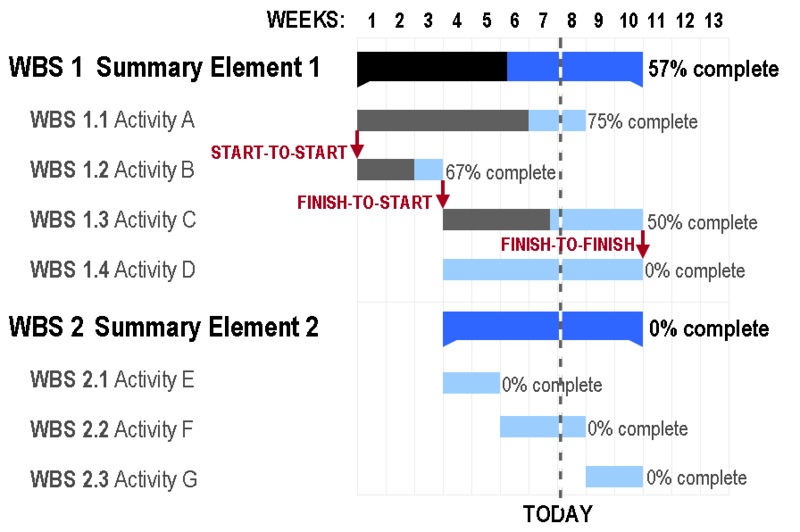
For projects with multiple milestones in planning, start-up, delivery, and completion; an Initiative Owner may consider using a simple Gantt chart to communicate with the Leadership team. Gantt charts model the progression of a project by individual tasks over time and can help a leadership team better understand a plan's progress in relation to other plans. See the image below for reference.

Follow Through

Leaders need to take responsibility for initiatives and milestones. Like your objectives and measures, you should report on the progress of completing your initiatives each month or quarter when you report on your Balanced Scorecard. Several things can cause red flags to go up with initiatives: you may be behind schedule, you may lack the resources, or you may be over budget.

Like objectives, you should flag initiatives as red, yellow, or green and come up with a plan to correct the initiative. Maybe the strategy has changed or it has become less important to complete the initiative within the given environment. Regardless, you need to report what you learn and demonstrate its impact on the execution of the strategy.

Successfully executing on your initiatives will increase your measures improving significantly over time. A disciplined focus on your key strategic initiatives will help your organization avoid distractions, eliminate wasted effort, and get results on the objectives that matter most.


Beyond the Boardroom: Building Excitement for the Strategic Plan

Posted December 1, 2010 11:02 AM by Dylan Miyake

How can leaders communicate excitement about strategic plans? Even the best strategies falter if the objectives and goals fail to resonate with the organization's key audiences. It's not enough for leaders to know where they want the organization to go.They also must find ways to effectively introduce upcoming challenges, explain options, listen to concerns about change, and develop consensus within the entire team, particularly those who keep the lights on, the doors open, and the customers smiling every day.

Encourage Opportunities for Feedback

Many employees may react with apprehension or skepticism – too often, "change" is seen as a synonym for "layoffs" or "more responsibilities." Counteracting resistance starts with sharing ideas across the organization and many positive suggestions for improvement originate with stakeholders in side-conversations encouraged throughout the development process.

Developing venues for "bottom up" communication enhances team performance and often reveals simple answers to problems that have been overlooked. In addition, leadership that extends this kind of courtesy and respect toward employees earns confidence and models healthy exchange of information.

Leadership should explain the big-picture ideas and challenges, then allow smaller focus groups of staff to seek answers. Encouraging solutions developed by the front line often alleviates apprehension and ensures availability of allies and experts throughout implementation.

Constructing "no-fault" systems for feedback from all employees makes it possible to address sensitive concerns that may impede the team's productivity. For example, designating a cafeteria comment box or an e-mail direct to leadership may facilitate insights - or identify log jams - that otherwise might not be forwarded in the typical chain of communication.

Leaders should try to get the most candid and unvarnished feedback; if an organization's staff thinks that the new strategy is a terrible idea, or if employees have major concerns, then leaders need to know and be prepared to adjust. Employees should be viewed as teammates and deserve credit in successful implementation of change. By frequently communicating and actively including their ideas- the strategic plan will have the momentum to overcome any trouble and be on a track for success.

Successfully Communicate the Strategic Plan

Organizations should create a variety of formats to talk about and explain the strategic plan. Some companies use video presentation to recount the organization's history, and then introduce their strategy to overcome current challenges and ensure future success.

Other communication ideas include:

  • Create a dedicated blog on the organization's intranet where elements of the strategic plan can be explained in greater detail – and make it possible for employees to post comments and questions (anonymously, if necessary – and as long as the anonymous comments are constructive). Bill Marriott's blog is a great example. •Host a series of brown bag lunches where the organization provides lunch so that employees can discuss the strategic plan with managers.
  • Send a monthly e-mail newsletter about various key points from the strategic plan – or incorporate the strategic plan into an existing newsletter, with a special article called "Strategy Corner." Invite new employees to write short articles giving their take on the plan; add a personal photograph to highlight a personal touch.
  • Use tangible objects to signal that real change is imminent. If your organization has a strategic goal of reducing waste and improving efficiency, replace everyone's wastebaskets with smaller ones, or install high-efficiency bulbs.
  • Offer certificates of award or appreciation to recognize good input. A nationwide organization of students awards a green brick every time a member goes "above-and-beyond" serving the organization. This simple award was created with two cans of spray paint and an hour of free time- but is now a highly prestigious trophy that influences behavior on a daily basis.

Be Their Biggest Supporter!

Use crystal clear language that people at all levels of the organization will understand and relate to. Engage your audience with a story about what success looks like. In the case of a Southwest baggage handler, expediting the baggage-handling procedure enabled the airline to add one more flight per day.

For hospitals, a single instance of proper hand washing can spare many from the risk of infection. Remember, everyone has a hand in fulfilling the organization's mission. The leaders' job is to include employees in the process, encourage them, and ensure they are equipped to move the organization toward success.

For more resources about implementing a strategic plan or enhancing communication within an organization, contact Ascendant Strategy Management Group.

Balanced Scorecard Measurement + Control Charting Theory

Posted November 20, 2010 9:52 AM by Dylan Miyake

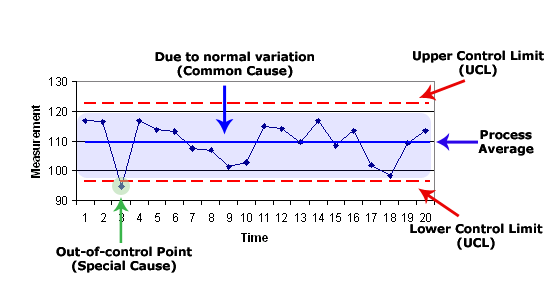
Control charts have long been used in manufacturing, stock trading algorithms, and in other process improvement methodologies like Six Sigma and Total Quality Management (TQM). The purpose of a control chart is to set upper and lower bounds of acceptable performance given normal variation. In other words, the control chart serves to "sound the alarm" when a process shifts (like a machine suddenly breaking on a factory floor) or if someone has a good breakthrough that needs to be documented and standardized across the larger organization. Here is an illustration: (citation) The Balanced Scorecard system typically uses a baseline, regular measurement and tracking against a target. Actual control charts might not be ideal for your Scorecard, however, the theory is still valuablewhen evaluating a measures behavior, either greatly up or down. Control charts at work – Examples: In industry, control charts are designed for speed: the faster the control charts respond following a process shift, the faster the engineers can identify the broken machine and return the system to producing quality products. At a factory, a lag in testing could mean that thousands of parts are produced incorrectly before anyone notices the machine is broken, resulting in wasted time, wasted materials, and angry customers. Similarly, at a non-profit organization, control charts could be used to determine when an online donation system has broken down or is receiving higher than normal usage, resulting in abnormal levels of donations. Should donations suddenly go to zero - the leadership team can quickly alert IT and ensure the system is brought back online. Alternatively, a major jump in donations means something good is happening- be it world events or a successful marketing campaign. Either way – leadership should know quickly when something is doing very well or very poorly compared to an average day. A government agency could use control charts to monitor security threats. Assuming there are between 15 and 30 threats per week, the agents know what to expect. One threat per week should be as alarming as should 75- as they both mean something is very abnormal. A school could use control charts to help evaluate attendance/absenteeism patterns. Let's assume, based on 2 years of analysis, that a school principal expects to see a certain level of student absences near holidays, with a typical range of 3% to 7% of students out. A control chart would plot along within the 3.1% to 6.9% range with no notice, but if 7.5% of students suddenly fail to show up for class, the lower control limit of 7% signals the alarm and the principal gets a call from attendance saying attention is required. Or conversely, if only 1% of students are absent, the upper control limit is surpassed, and the principal begins looking for reasons why the attendance is suddenly so much better than usual. Is there a pep rally or other event that motivates students to come to school at a time of year when they're more likely to be absent? Control Charts and the Balanced Scorecard Control charts can be used as part of the Balanced Scorecard approach to account for an acceptable range or variation of performance – it provides a more nuanced understanding of the organization's processes. There are a few key points to keep in mind when considering using control charts at your organization: Give it time Don't expect to see immediate results or instant insights from a control chart. It takes a number of months or years to understand natural variation and baseline "normal" performance (as the environment has some control on your measures and can distract from your own input). Watch for the "Big Movers" Control charts can help track and measure variation in a process over time. There is going to be a certain amount of variation as part of normal operations – small variation is nothing to worry about. Instead, focus your attention on major jumps or falls – these are the places where your organization needs to concentrate its efforts. Results matter – and results should be visible Process improvement initiatives should cause a metric to rise above the upper control limit – showing that there was a statistically significant shift in the objective's measure. Control charts give you a clear chance to see results and act on them – and if not, it might be time to try something new. Don't get bogged down. Control charts can be complicated – they were developed by engineers, after all! But your organization can keep your control charts as simple as you need them to be. Extremely complex math is still being developed in the operations research field to better understand process variation and how to account for it via control charts – but the typical leader at a service organization doesn't need to worry about going to that level of detail. Instead, try to identify the acceptable upper and lower limits for each key metric that you want to track, and keep the overall theory of limits in mind when reviewing your control charts. Develop an action plan for how to respond when the latest measure lands outside the acceptable limits. __ If you would like to learn more about how the Balanced Scorecard can help "chart" a path to success for your organization, please contact Ascendant Strategy Management Group.

Who owns your organization’s strategy?

Posted November 15, 2010 8:45 AM by Dylan Miyake

One of the first questions that public sector and non-profit leaders need to ask when embarking on a new strategy management initiative is: "Who are the Owners of the strategy?"

Who is accountable for establishing and maintaining the objectives, measures, and initiatives that will determine whether your organization's strategy succeeds? These are the Owners. And their role is one of the most important in your organization. Whether your new strategy succeeds will depend in large part on the kind of Owners you have working to implement it.

Who is an Owner?

Being an Owner of organizational strategy is not necessarily a job title or part of a job description. Owners are leaders within the organization who act as champions for certain parts of an organization's strategy (or certain measures of the organization's Balanced Scorecard), and who oversee communication and training so that the organization's strategy becomes ingrained in the overall culture of the organization. There can be plenty of layers of supporting staff and data analysts, but the Owners are the ones who are manage and are accountable for achieving certain objectives.

The four types of Owners

Every organizational strategy has four types of owners, with responsibilities for varying areas of responsibilities:

  • Scorecard Owners set the tone for the work done by the other owners. Scorecard owners work on high-level questions such as issue definition (identifying the specific strategic issues that need to be addressed), agenda setting (deciding on a course of action for the group's activities), and meeting preparation (aligning the work of various owners and marshalling the group's latest data to discuss at the next strategy meeting).
  • Objective/Theme Owners provide analysis and commentary about the specific objectives – a finer level of detail than the overall Scorecard itself.
  • Measure Owners provide performance analysis about specific measures as outlined on the organization's Balanced Scorecard.
  • Initiative Owners provide performance analysis on strategic initiatives and help evaluate whether the organization's top projects are on track and helping deliver results.

Owner and Data Analyst: Separate but Supporting Roles

One of the most important roles of Owners, especially as it relates to the organization's Balanced Scorecard, is to ensure the most accurate data is analyzed and presented at strategy review meetings. While the owner may not be specifically responsible for the day-to-day tracking, they are responsible for the data's accuracy and the value of the analysis – and ultimately for championing the required actions in the highest circles of organizational leadership.

Each owner typically has one of more "data analysts" supporting themselves. Owners are usually not ideal for this role as it is more time consuming, more focused on collection, and is not directly related to strategic analysis or action. The data analysts collect the numbers, verify they are accurate, compile any supporting documents, and ensure the owner is knowledgeable of any emerging trends.

  • "Data Analyst" – in this role, supporting staff needs to collect updates from different parts of the organization, and tabulate and graph the data for each measure. For example, a school district might need to track student test scores, graduation rates, dropout rates, or the percentage of students going on to enroll in college. Collecting and analyzing these data is a complex task, but once the numbers are in order and emerging trends identified, the data analyst passes the information the Owner.
  • "Owner and Champion" – in the role of Owners, the champions of strategy are responsible for providing recommendations for future action based on the data compiled. Owners review the graph and investigate the underlying data to understand why the measure is behaving as it is, then suggest, act upon, and ensure strategic objectives are being acted upon.

For example, if a school district's graduation rates are down and dropout rates are up, they might analyze some of the risk factors for dropouts – has the community suffered an economic downturn, leading to increased financial stress on families? Have the demographics of the district changed in the past few years, bringing a greater proportion of students who are at higher risk of dropping out of school? Then, as champion, what can they do to ensure the organization achieves its mission? Are new programs required? Should funding or resources be realigned to meet new challenges? These are the questions and resulting actions an Owner is responsible for.

While it might seem obvious, the Owner, needs to be have the right level of authority to make changes that will drive the measure towards the intent of the organizational objective. The authority should appropriate both formally (by title and job description) and informally (authority is recognized and honored by the organization) to ensure success. Owners need to be empowered and confident that they can act and to spur change within the organization. No matter the challenge, Owners ultimately have to be able to drive the organization forward in response to the findings.

The importance of reporting: managing "small things"

In addition to these higher-profile instances of managing change in response to new data, Owners also have an important leadership role in the ongoing task of enforcing behavior and sticking to a reporting calendar.

Maintaining a solid regimen of reporting is one of the most critical tasks of the Owners. If your organization is serious about performance management and staying on track with your strategy, you need Owners who will work to ensure that the Balanced Scorecard stays relevant, that the data and analysis are accurate and result in clear decision making, and that decisions are acted upon.


Balanced Scorecard Reporting

Posted November 11, 2010 2:06 PM by Ted Jackson

What makes a good Balanced Scorecard report? I have written in this blog many times about the need to have regular reporting and how to prepare for the report, but I continually get the question about what is a good one or bad one? Let me quickly state that a good report is one that provides useful information to the leadership team of an organization so that they can discuss and make decisions about their strategy. Well, if you know anything about Ascendant and the Balanced Scorecard, you have probably read or heard that answer before. This blog attempts to provide a few more details.

more »

Election Special - Expectations in Public Sector Performance Management

Posted October 28, 2010 5:58 PM by Dylan Miyake

With increasingly high stakes - politicians and leaders across the country are focusing on results. Be it unemployment numbers or budget deficit projections, effective performance management is in increasingly high demand. Thanks to incredible investments by large organizations, powerful tracking systems are now available to even the smallest groups.This doesn't mean every public sector and non-profit organization should focus on earning more revenue and managing costs – after all, public sector organizations and non-profits have different goals and answer to different constituencies than businesses. What it does mean is that many leaders of public sector organizations need access to the tools and information so they can operate more like a business – with better metrics for efficiency, accountability, and an overall sense of precision in the organization's focus and results. So why is public sector performance management gaining such momentum? Systems that work: Corporations and intelligence agencies paid a premium over the years to develop IT systems to measure and track all aspects of an organization's work – and now these same powerful systems are becoming available at reasonable prices to non-profit and governmental organizations. Higher expectations: People are impatient for data. Expectations for quality and timeliness of data delivered to decision makers have grown – people don't want to wait to learn what they need to know about your organization. Anyone who needs data about your organization – whether they're executives, lenders, donors, volunteers, partner organizations, or even public officials working on legislation related to your organization's mission who need real statistics to prove a need – wants to be able to find relevant information as quickly as possible. Risk management: It's a risky world, and your organization increasingly needs to track all sorts of data, from sentinel events in a hospital (unexpected events leading to death, serious injury or the risk thereof), the number of EEO complaints in the workplace, student test scores for No Child Left Behind, or the number of fatalities on state highways tracked by the state Department of Transportation. Better performance management can help your organization track the numbers you need to promote your mission and defend your reputation. Competition: At a time of shrinking budgets, decreasing donations and ever-scarcer resources, programs that cannot prove their effectiveness are seeing major funding cuts, while programs that can point to metrics and data to prove their effectiveness are attracting more resources. Performance management can help your organization prove that you get quantifiable results – and that you're being a good steward of your resources. Accountability: Every organization needs to maximize its effectiveness, which means that every individual employee is under greater scrutiny and has to be accountable for performance. Better performance management can help your organization develop performance plans (for individuals, teams and larger departments), specific performance targets, and a method of tracking progress on the individual level or organization-wide. You can see these trends at work in many different public sector organizations. One of the major driving forces behind the new emphasis on performance management is not only a "reactive" measure in response to public scrutiny, but also a "proactive" measure by organizations looking to promote their work and raise awareness of their positive results. For example, in Washington DC, the Washington Metropolitan Area Transit Authority has posted an online Metro Scorecard showing various performance metrics for the city's public transit systems, including cost per ride (and subsidy per ride), on-time performance, and employee and customer injury rates. Many public sector leaders use performance management data as a way to prove that their organizations are doing a better job than the media tend to report. Increase Interactions with Constituents and Stakeholders: Another driving factor behind the shift to performance management is a reflection of the larger consumer culture – in the era of social media, when dealing with private sector brands, customers expect their favorite brands to be interactive, to respond to their ideas and demands, and all with a certain level of brand humor and "sex appeal" in the products they purchase. Gatorade has taken listening to the customer to a whole new level with their new Mission Control team – a group of social media operatives at Gatorade headquarters who constantly monitor and respond to feedback about Gatorade on Facebook, Twitter and other social media. The goal is to have a rapid response to customers' ideas, feedback and criticism, and engage customers in conversations to improve customer loyalty and sales. What does this mean to your organization? The fact is, right now, people are talking about your organization, in public, on blogs, Facebook, Twitter and other social media. They might be praising your staff, expressing complaints, or offering useful suggestions. Many public sector organizations have a big opportunity to increase their presence on social media, engage in conversations with constituents – not only for immediate customer service needs, but also for longer-term awareness and public support of the organization's mission. This kind of heightened responsiveness to your constituents' needs is another aspect of public sector performance management that is going to continue to grow in importance. Performance management will be an enduring part of any public sector or non-profit organization's operational future. If you want to learn more about how your organization can improve its performance, develop strategic alignment, and develop metrics that pinpoint your performance, contact Ascendant Strategy Management Group for guidance.

Tweet This - http://tinyurl.com/3yjjcmd

Posted October 18, 2010 11:14 PM by Dylan Miyake

There are three big trends in Web marketing that non-profits should pay attention to: Online Advertising (including mobile marketing), Social Media (like Twitter and Facebook), and an updated understanding of Website Metrics. The new world of online media, social media and mobile technology is presenting significant opportunities for organizations that are ready to embrace change. If you're ready to include Web marketing in your organization's mix of methods for fundraising, outreach and communications, continue reading below.Online advertising: Be ready to "pay per click" and "go mobile". Google recently announced strong 3rd quarter earnings, indicating a 20 percent annual increase in revenues from its AdSense online advertising programs. Paid clicks on Google are up 16% - showing that people are becoming more likely to use paid links to find the information they're looking for. Another big trend in online marketing is mobile marketing – web ads and messaging designed specifically for smart phones. According to the Mobile Commerce Forum, mobile Web users are expected to spend $119 billion a year by 2015 – and this shift in buying behavior has implications for non-profit fundraising as well. As people become more comfortable searching, shopping and spending from their mobile phones and personal electronic devices, they also will become more willing to donate. Even small text message-based donations can make a huge difference – the Red Cross raised millions of dollars after the Haiti earthquake by asking people to send $5 or $10 donations via text message. These trends are real, and they are likely to continue to grow – there is an army of people using smart phones for information on the go, and they are open to interacting with (and donating to) their favorite non-profits. Are you ready to extend the invitation? Amplified "word of mouth" Millions of words have been written about how social media is changing everything in the world of online marketing. Some non-profit organizations have been a bit slow to embrace these new opportunities – either due to a lack of resources, a lack of understanding of the new technology, or by not seeing connections between the new media and the organization's existing goals and constituencies. Non-profits are constantly looking for new ways to educate, congregate, and cause some action in a group of people. Using social media like Twitter and Facebook can be a fun and effective way to achieve these objectives. Whether your organization is experienced in social media, or whether you're still learning the difference between Twitter and Facebook, here are some tips to help improve your social media footprint to engage with your stakeholders online. Twitter: By posting timely, relevant messages 140 characters at a time, your organization can mobilize a volunteer workforce. Here are some of the types of "tweets" you can send to engage with your organization's friends and fans online: •From a church's outreach office: "Father-son softball tonight at Tall Oak park, 6 p.m., All welcome!" •From a homeless shelter: "We need volunteers to serve dinner during Thanksgiving week – contact www.tinyurl.com/### by November 10 for details." •From a local public official: "Would you like to serve on the Mayor's public recreation advisory board? Short-term commitment, big opportunity to make a difference." You can adjust your Twitter settings (or use more advanced Twitter platforms like "TweetDeck") to automatically post your Twitter messages to your Facebook page as well – saving time and effort. Facebook: The world's most popular social networking site has over 500 million users worldwide (and counting). Does your organization have a fan page on Facebook yet? Facebook, like Twitter, can be a valuable resource to cultivate donors and recruit volunteers, post announcements, build excitement for upcoming events, and share the mission and expertise of your organization. One difference between Facebook and Twitter is that Facebook is not limited to 140 characters per post – so you can be more expansive. It's also a bit easier to upload videos, photos and links via Facebook. How to get more Friends and Followers: There are no hard and fast "rules" for social media for non-profits, but there are a few key principles to keep in mind: •Interact: There's a reason why they call it "social" media – you're supposed to treat it like a conversation, not a monologue. One of the best ways to find more followers for your organization is to interact with people – in a personal and authentic way. Respond to comments about your organization, and get involved in blog discussions or online forums about the issues your organization addresses. •Be patient: It takes time to build up a big social media presence; it doesn't happen overnight. Assign someone at your organization to spend some time every day on Twitter searching for mentions of your organization and sending "@ replies" to the people who have positive things to say. Find the people who are already talking about your organization, and follow them – often they will follow you back. •Reach out: Do a Google search and find bloggers who are writing about your organization, reach out to them and ask them to refer people to your Facebook page. •Build on existing contacts: Send a mass e-mail to your existing donors, volunteers and fans, and invite them to join you online. Make it easy to connect to your Facebook and Twitter pages by posting buttons on your website Contact page, from your blog posts, and everywhere else you have a presence on line. Finding effective website metrics Every non-profit organization should have a website, no matter how basic. But do you know what your website means? You need to have a way to identify relevant information and track metrics to show how your website is supporting your organization's overall goals – and these metrics should be included and tracked on your Balanced Scorecard. Potential BSC Key Performance Indicators •Number of viewers: How many people are visiting your website each day, week, and month? What are the peak visit days? How many unique visitors do you have? •Length of site visit: How long are people hanging around on your website? Do you have enough interesting content to keep people's attention, or do they just drop by briefly and then move on to something else? •Days since last update: One of the most important ways to keep your website at the top of the Google search results is to refresh your site regularly with new content – especially with blog posts or social media feeds (you can connect your Twitter feed so that all of your Tweets appear on your website as well). By tracking the days since last update, you can give your staff another measurable performance goal to track on the Balanced Scorecard. •Number of Twitter followers and Facebook friends: quality is more important than quantity, but quantity doesn't hurt – and this gives you a way to track whether your online efforts are getting attention. •Number of Twitter @ replies – track how many people are forwarding your messages and spreading the word to others? Are you "Findable" online? Another related goal for your organization's website should be to make sure that your website is up-to-date on Google, Bing, and MapQuest Maps with your organization's phone number, address and hours (if that is important to your organization). Social media has matured and it's time to join professionally. The tools impact real users, create real events, and result in real donations. If your organization would like guidance in this field of strategic impact, we would be honored to work with your organization. Just an email or phone call can start the conversation.


more entries »